

Four durable AV system changes reshaping corporate general sessions.
A durable system change alters the brief, content workflow, control model, or reuse plan across multiple programs. These four changes meet that test, but each still requires evidence, limitations, and a program-specific buying decision.
Technology matters when it changes a durable production decision. A useful review asks what capability became practical, which new dependencies came with it, where an older method still fits, and what evidence a buyer should require before funding the change.
The four systems below are not mandatory architecture. They are planning categories that now connect display, content, camera, network, control, rehearsal, and recorded deliverables more tightly than a conventional equipment list reveals.
Display systems became configurable environments
Modular direct-view LED can form flat, concave, convex, corner, and other supported configurations. Current manufacturer documentation for the ROE Visual Diamond series, for example, describes flat and curved mounting. That product evidence supports the capability, not a claim that every panel, curve, structure, room, or camera plan will perform the same way.
Buyer implication: define the image function, physical geometry, viewing positions, camera positions, ambient-light condition, content canvas, processing, structure, power, installation method, service access, and acceptance test as one display system. A creative shape without native content, physical clearance, or camera validation is not a complete design.
Limitations: projection, monitors, reusable scenic, printed media, or a simpler flat canvas may be better when the room, architecture, schedule, budget, reuse plan, or visual function supports them. The display-system decision table keeps that comparison neutral.
General sessions are designed for live and recorded uses
The room, image magnification, live stream, isolated recordings, edited sessions, clips, and internal archive can be distinct deliverables. Treating the general session as recorded media brings rights, framing, graphics, captions, audio loudness, file naming, metadata, retention, and editorial handoff into preproduction.
Buyer implication: approve a deliverable matrix before the camera and content plans. It should identify audience, resolution and frame rate, aspect ratio, clean or branded feed, audio and language versions, captions, rights, record format, edit state, destination, retention, acceptance check, and owner. The EBU R 128 loudness recommendation is one current technical reference for broadcast loudness normalization, but the required delivery specification still comes from the approved destination and use.
Limitations: more feeds and isolated records add routing, storage, monitoring, rights review, postproduction, and quality-control work. Capture should follow an approved use, not the assumption that every output will become reusable content.
Control is moving from device lists to managed flows
Professional media systems increasingly separate video, audio, timing, metadata, discovery, connection, and control concerns. The SMPTE ST 2110 suite defines timed professional video, audio, and data over managed IP networks. The AMWA NMOS specifications cover functions such as discovery, registration, connection management, audio channel mapping, authorization, and control.
Those standards show why production control and data flow now belong in the system brief. They do not mean every ballroom needs ST 2110 or NMOS. A program may use baseband, proprietary media networking, general-purpose IP transport, or a hybrid design. The relevant buyer questions are how sources and destinations are identified, how timing is maintained, how connections are authorized, how state is monitored, how configurations are versioned, and how operators recover the required program.
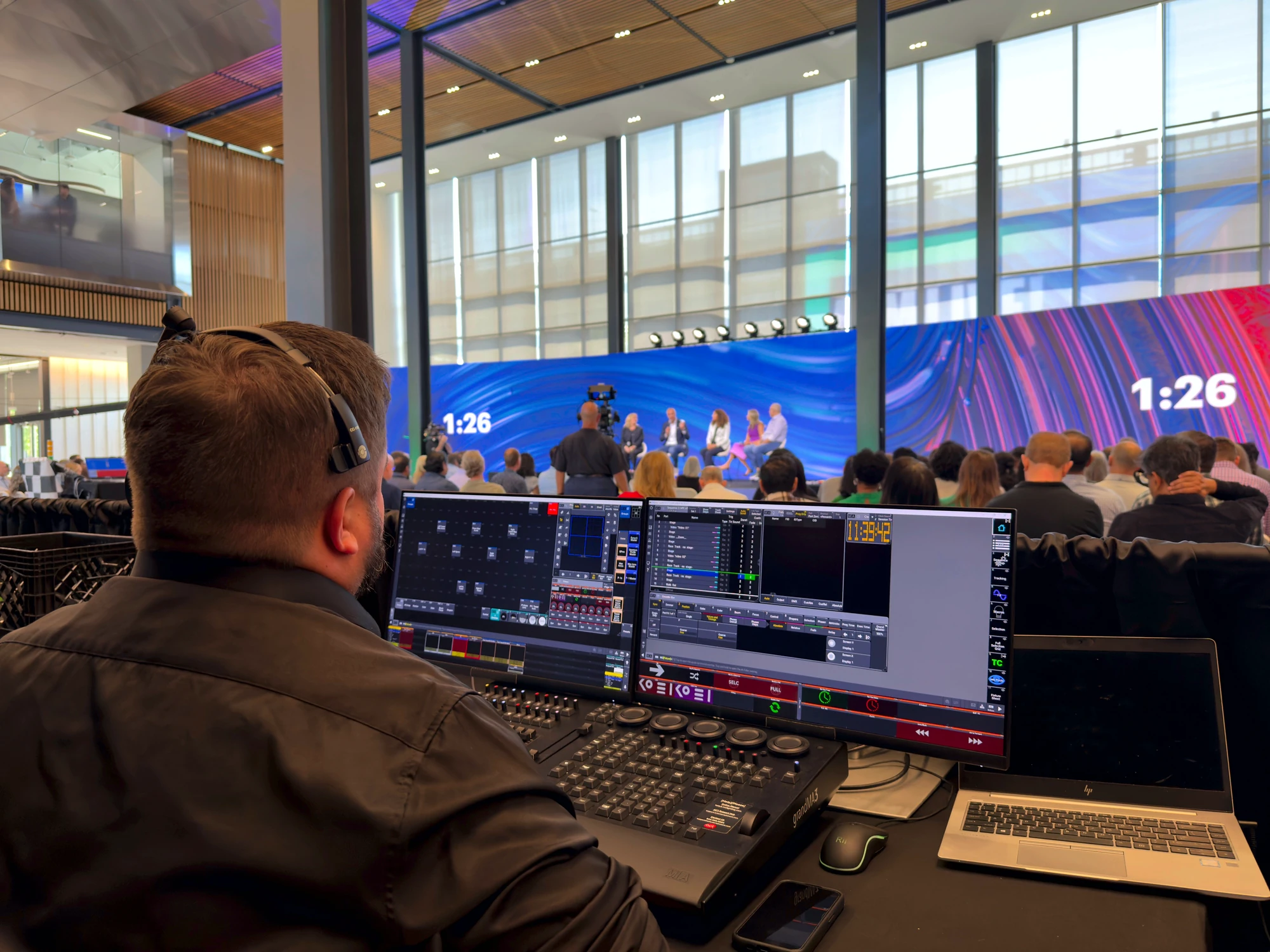
Limitations: networked media adds switch configuration, capacity planning, timing, addressing, security, telemetry, interoperability testing, and specialist operating requirements. A network link is not automatically an independent path, and standards alignment does not remove the need for an acceptance test.
Virtual production fits a repeatable camera-content need
Virtual production can combine an LED environment, real-time rendering, camera tracking, calibration, timing, and synchronized render systems so a camera records a composed environment. Epic's current in-camera VFX overview documents dependencies including the LED stage, camera tracking, render nodes, network, master clock, calibration, timecode, and genlock.
Buyer implication: fund this system when the program has a repeatable camera-based content need, such as a defined set of controlled segments, product footage, executive records, or reusable scenes that justify the environment and content pipeline. Approve shot requirements, camera movement, lenses, tracking, render performance, content states, color workflow, rehearsal, fallback, and final deliverables before selecting the stage.
Limitations: an attendee-first live presentation, wide multi-angle coverage, limited content-development window, changing speaker blocking, or a one-time background may favor physical scenic, standard playback, compositing, or a simpler LED approach. The decision should follow the shots and repeatable content need, not the presence of a real-time engine.
Durable-system decision record
Complete one row before approving design or budget. Decision criteria and limitations belong beside the capability so a visually attractive option is not mistaken for a complete production case.
| System change | Durable capability | Decision criteria | Limitations to carry | Evidence before approval |
|---|---|---|---|---|
| Flexible display systems | Image geometry can be designed with supported modular configurations | Viewing, cameras, content, room, structure, power, service, reuse | Panel and geometry limits, physical fit, content burden, alternatives | Drawings, manufacturer data, content map, structural and camera test |
| General session as recorded media | Live program can support approved stream, record, edit, clip, and archive uses | Audience, rights, versions, captions, audio, format, retention, ownership | Added capture, routing, storage, review, postproduction, and quality control | Deliverable matrix, rights approval, test records, sample file validation |
| Production control and data flow | Sources, destinations, timing, metadata, and state can be managed as a system | Scale, interoperability, authorization, monitoring, versioning, recovery | Network engineering, timing, security, telemetry, specialist operation | Architecture, capacity basis, interface list, configuration and recovery test |
| Virtual production | Tracked cameras can record approved real-time environments | Repeatable shots, content life, stage, camera, tracking, render, color, fallback | Content build, synchronization, calibration, performance, angle and stage constraints | Shot list, technical test, content benchmark, calibration and fallback record |
Current technical sources
Sources were checked August 6, 2026. Manufacturer documentation supports only the cited product capability; standards and software documentation explain their stated technical scope. None establishes a default architecture for a corporate event.
- ROE Visual, Diamond Series: documented flat, concave, and convex mounting capability.
- European Broadcasting Union, R 128: current loudness-normalization recommendation and descriptors.
- SMPTE, ST 2110 suite: timed professional video, audio, and data over managed IP networks.
- AMWA, NMOS interface specifications: current specification set for discovery, connection, control, and related functions.
- Epic Games, In-Camera VFX Overview: current system components, camera tracking, calibration, timing, and operational dependencies.
Fund the system change only when the program can use it.
Use the audience, room, camera and recorded deliverables, content lifecycle, operating constraints, and current system assumptions to expose which capability has a repeatable job and which adds avoidable dependencies.