

The published project record documents separate room and broadcast mixes on Allen & Heath Avantis consoles, Dante audio between consoles and venues, a Meyer Sound room system, Shure Axient wireless, Smaart measurement, five language feeds, live captions, and a venue power loss ahead of a session. This retrospective uses those facts and does not reconstruct an undocumented cable-level as-built.
Separate recorded facts from transferable signal logic
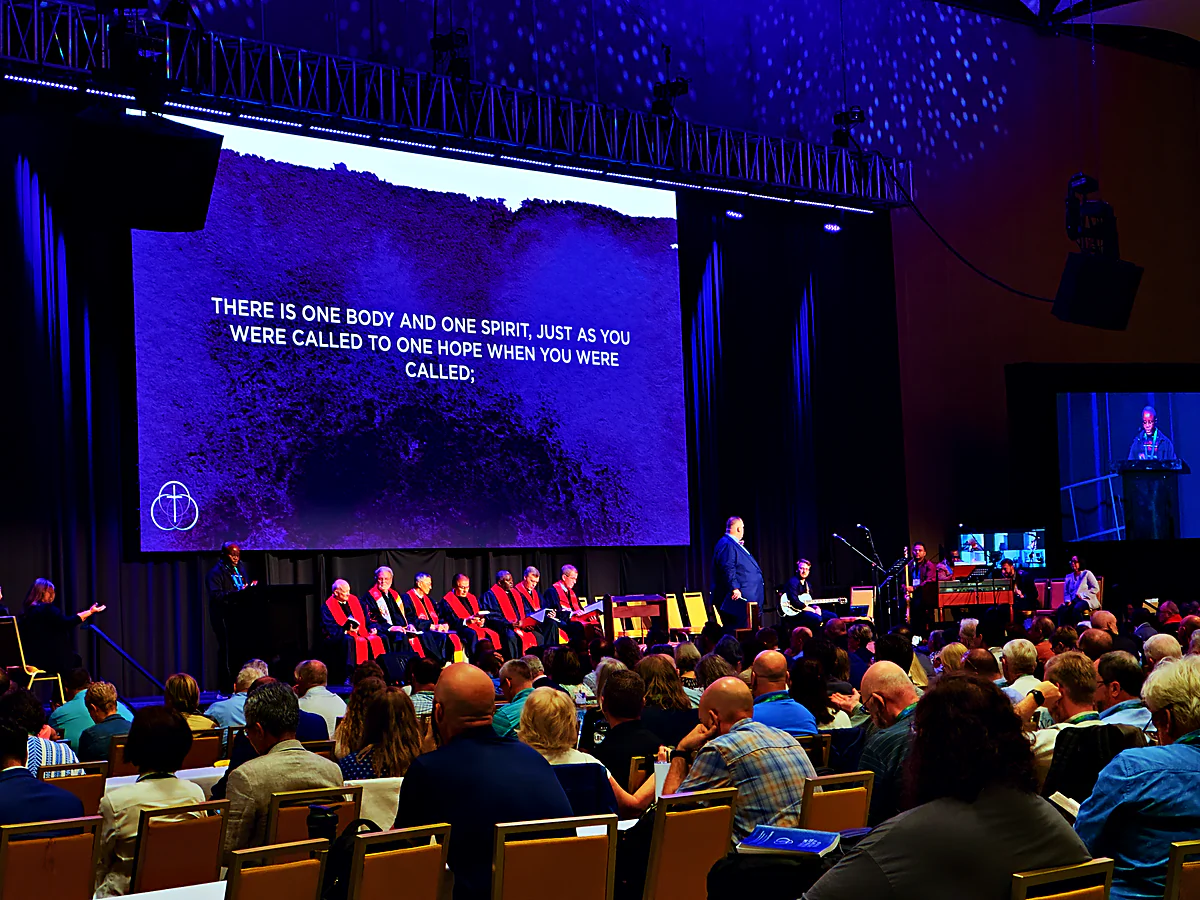
The 2024 Convening General Conference brought the Global Methodist Church's program to delegates in Costa Rica and viewers beyond the venue through live broadcast, real-time audio and caption translation, breakout coverage, and a custom streaming platform. The audio record is specific enough to explain functional routing and operating responsibilities, but it does not preserve channel counts, network topology, console-file details, power distribution, or a complete input and output schedule.
That boundary matters. A retrospective should reveal why the system was divided into room, broadcast, interpretation, contribution, return, and monitoring functions without turning one engagement into a universal architecture.
The room mix served the physical space
The documented room path combined Shure Axient handheld and lavalier sources, an Allen & Heath Avantis console, a Meyer Sound loudspeaker system, and Smaart measurement. The room mix could respond to the acoustics, loudspeaker coverage, live music, speech, and the audience in front of the system.
The transferable decision is functional separation. Changes required for the room should not automatically become changes for remote listeners, interpretation feeds, or records. The exact console and routing method can vary; the approved deliverables determine the separation required.
The broadcast mix served the remote program
A separate broadcast mix was built for the stream and carried through independent routing on the Avantis consoles. That allowed broadcast balance and program treatment to be managed for remote listening rather than inherited from the loudspeaker mix.
A broadcast mix also needs an explicit source list and destination record: which microphones, playback, interpretation returns, room ambience, stings, remote contributions, captions, and program versions belong in each output. The project record confirms the separate mix; it does not justify inventing an undocumented bus or channel assignment.
Five language feeds were separated and monitored
The documented working languages were Swahili, French, Spanish, Korean, and English. Each language was carried as a separate interpretation feed and monitored on its own path. Live captioning ran alongside the audio workflow for access beyond the room.
For each language, a current plan should identify source program, interpreter input, language output, room and remote destination, selection method, monitoring point, caption relationship, operator, and test phrase or known reference. That is signal governance, not simply adding another audio channel.
Inter-venue audio required direction, timing, and ownership
The published record confirms that Dante carried audio between consoles and venues. It does not retain a channel-by-channel contribution and return schedule, so this account does not assign undocumented directions or endpoints.
The durable planning lesson is to label the two functions separately. Contribution identifies audio entering a common program from another room, console, or remote source. Return identifies program, mix-minus, interpretation, confidence, or cue audio sent back to a room or contributor. Each path needs a source, destination, timing basis, level reference, monitoring point, owner, and recovery action.
Monitor each output as its audience receives it
The record states that the language feeds were monitored individually and that Smaart was used to measure the room systems. Those are different forms of evidence: system measurement for the physical listening environment and output monitoring for routed program feeds.
A current monitoring plan should separate input presence, room-system performance, console buses, network transport, broadcast output, each interpretation feed, captions, destination playback, and contribution or return confidence. A single solo bus or meter cannot represent every audience path.
The documented power event tested the response
The venue lost power ahead of a session. The documented response was to isolate the fault, restore power within the hour, and keep the program on schedule. The source record does not specify the fault location, backup-power topology, transfer sequence, or equipment restart order, so no further system claim is added here.
What can be carried forward is the operating discipline: assign isolation, venue coordination, technical validation, program timing, and go or no-go authority before the incident. Rehearse the response in the order the system must return, including network timing, consoles, wireless, room outputs, broadcast mix, interpretation feeds, captions, recordings, and endpoint monitoring. A rehearsed response is a sequence with owners and evidence, not a generic assurance.
Signal-flow logic
This accessible ordered map represents the documented functions without pretending to be the missing as-built diagram. Use it as a review sequence for a multilingual room and broadcast plan.
- 1. Sources. Confirm every microphone, playback, remote, room, and interpreter source that each audience path requires.
- 2. Console inputs and routing. Record the owning console, input name, timing reference, split or route, and fallback state.
- 3. Room mix. Route the approved local program to the measured room system and verify representative audience positions.
- 4. Broadcast mix. Build and monitor the separate remote program from its approved source list.
- 5. Interpretation feeds. Keep each approved language output distinct and verify selection, intelligibility, alignment, and destination.
- 6. Contribution and return paths. Label direction, source, destination, timing, mix-minus or confidence function where applicable, and recovery owner.
- 7. Monitoring and records. Listen and view at the room, routed outputs, broadcast destination, language endpoints, captions, and required recordings.
- 8. Power and recovery. Confirm startup order, validation points, decision authority, communications, and the rehearsal record for each critical state.
The broader project context is documented in the Costa Rica case study. Production planning upstream of the signal map is covered in the global conference production guide.
Approve the language and endpoint map before the console file.
Trace the rooms, sources, broadcast destinations, language list, caption requirements, contribution and return needs, monitoring positions, and recovery owners. Those inputs establish the audio functions that need to be designed and tested.